
### FTGO应用的架构
FTGO is a typical enterprise Java application. Figure 1.1 shows its architecture. The FTGO application has a hexagonal【六边形】 architecture, which is an architectural style described in more detail in chapter 2. In a hexagonal architecture, the core of the application consists of the business logic. Surrounding the business logic are various adapters that implement UIs and integrate with external systems.
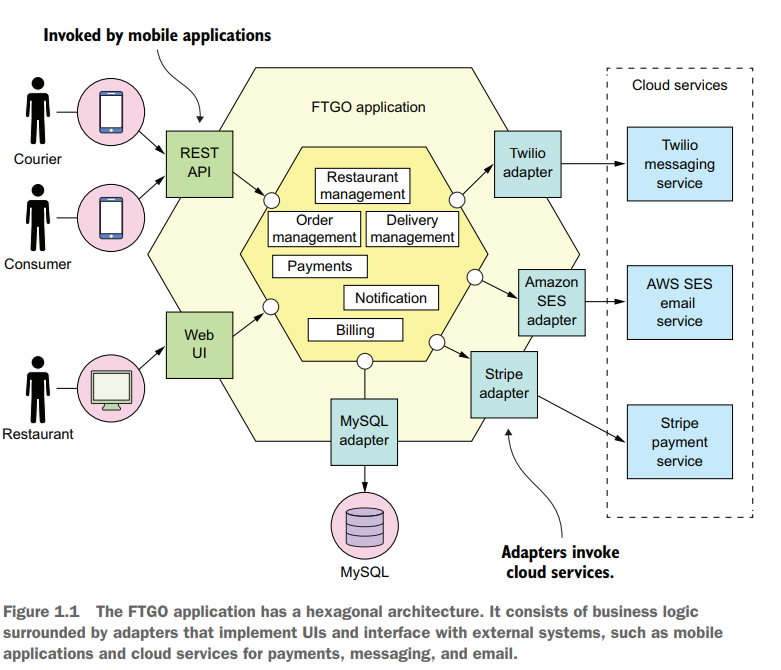
The business logic consists of modules, each of which is a collection of domain objects. Examples of the modules include Order Management, Delivery Management, Billing, and Payments. There are several adapters that interface with the external systems. Some are inbound adapters, which handle requests by invoking the business logic, including the REST API and Web UI adapters. Others are outbound adapters, which enable the business logic to access the MySQL database and invoke cloud services such as Twilio and Stripe. Despite having a logically modular architecture, the FTGO application is packaged as a single WAR file. The application is an example of the widely used monolithic style of software architecture, which structures a system as a single executable or deployable component. If the FTGO application were written in the Go language (GoLang), it would be a single executable. A Ruby or NodeJS version of the application would be a single directory hierarchy of source code. The monolithic architecture isn’t inherently bad. The FTGO developers made a good decision when they picked monolithic architecture for their application.
- 空白目录
- 1. Escaping monolithic hell
- 1.1 The slow march toward monolithic hell
- 1.1.1 The architecture of the FTGO application
- 1.1.2 The benefits of the monolithic architecture
- 1.2 Why this book is relevant to you
- 1.3 What you’ll learn in this book
- 1.4 Microservice architecture to the rescue
- 1.5 Benefits and drawbacks of the microservice architecture
- 1.6 The Microservice architecture pattern language
- 1.7 Beyond microservices: Process and organization
- 2. Decomposition strategies